 goSmash
Most players walk off court knowing they played badly — but not why. "I was flat today" is not a diagnosis. It's a feeling. And feelings don't turn into drills.
If you want to improve without a full-time coach, you need a process for watching your own matches. Not a vague "I'll review the footage later," but a real framework that takes a one-hour match and turns it into two or three concrete things to work on this week.
This is that framework. It's the same one coaches use when they sit down with a player and a laptop. You don't need expensive software — a phone, a tripod, and an hour of focused attention will do.
Why self-analysis beats playing more matches
Here's the uncomfortable truth: if you could improve just by playing more, you'd already be a better player. Most club-level players have thousands of hours of match experience and still plateau. The reason is simple — during a match, you're too busy reacting to notice patterns. Your brain filters out everything except the next rally.
Watching yourself play is the first time you see what you actually do, not what you think you do. Most players are shocked the first time. Your serve isn't as deceptive as it felt. Your footwork to the forehand corner is an entire beat slow. You telegraph your cross-court drop every single time.
None of this is visible from inside the point. All of it is obvious on video.
Step 1: Record the match properly
Bad footage makes analysis impossible. Before you worry about what to look for, get the capture right.
- Camera position: Back of the court, elevated if possible. A tripod on top of a chair or bag works. You want the entire court in frame including both service lines.
- Height: Higher is better. Eye-level footage hides shuttle trajectory and court positioning. If you can get 2–3 metres up, your analysis becomes 10× more useful.
- Frame rate: 30 fps is fine for shot-by-shot review. 60 fps is better if your phone supports it — you'll be able to pause on contact frames clearly.
- Audio on: Shuttle contact sound is surprisingly informative. A crisp "thwack" on smashes versus a dull "thunk" tells you whether you hit the sweet spot.
- Record the whole match: Don't stop and start. You need warmup patterns, early-game energy, and late-game fatigue all in one file.
Pro tip: label the file immediately — 2026-04-07_vs-rahul_singles.mp4. In six months when you want to compare, you'll be grateful.
Step 2: The first pass — watch without judging
Resist the urge to open a notebook and start dissecting. Your first watch-through is a full-match playback at normal speed with one goal: notice what surprises you.
You already have a story in your head about how the match went. "I lost because my smash wasn't working." "I couldn't handle his drops." The first pass is to check whether the story matches reality. Usually it doesn't.
Things to watch for on the first pass:
- Rally length patterns — are you losing long rallies or short ones?
- Score context — which points did you lose when it mattered (11–11, 18–18)?
- Energy and body language — when did you stop moving with intent?
- Shot selection surprises — did you actually play the "safe" shot you thought you played?
Don't pause. Don't rewind. Just watch and let it land. Write down three or four things that surprised you — that's the list your second pass will investigate.
Step 3: The second pass — the shot census
Now you get tactical. The goal of the second pass is to count what happened. Not to judge it — just to count it.
Open a spreadsheet (or just a notes app) with these columns:
- Rally number (1, 2, 3...)
- Outcome (won / lost)
- Rally length (number of shots)
- Last shot you played (smash, clear, drop, net, drive, serve, lift)
- How it ended (winner, unforced error, forced error, opponent winner)
This takes about 20–30 minutes for a full match. Skip the warmup. You don't need to capture every shot in every rally — just the last one (what ended the rally) and any obvious highlight mid-rally.
When you're done, you have gold. Now you can answer questions your memory can't:
- What percentage of your rallies ended in unforced errors?
- Which shot type generates the most unforced errors for you?
- Are you winning more points on offence or defence?
- In rallies longer than 10 shots, who wins more often — you or your opponent?
Three or four sessions of this and a pattern emerges. Almost always, 60–70% of your losses trace back to one or two specific shot types. That's your top priority.
Step 4: The technique pass — pause and look closely
With the pattern identified, go back and rewatch the specific shots. If the census says you lost 12 points on errored net shots, pull up all 12 and pause on each one.
What to check, in order:
- Footwork arrival: Were you balanced when you hit the shot, or still moving? The most common cause of bad net shots isn't the racket — it's arriving late.
- Body position: Is your non-racket arm up? Are your shoulders square or twisted? Are you bending at the waist instead of the knees?
- Contact point: Is the shuttle in front of your body or beside it? In front is almost always better.
- Racket face at contact: Open? Closed? Is the face direction consistent with where the shot actually went?
- Follow-through: Where is the racket ending up? A follow-through that crosses your body usually means you reached instead of moving.
You don't need to be a biomechanics expert. You just need to notice differences between the shots you executed well and the shots that failed. The differences are almost always obvious when you compare them side by side.
Step 5: The movement pass — watch without the shuttle
This one is underrated. Play the match back again, but this time ignore the shuttle entirely. Just watch your feet.
You're looking for three things:
- Base position: After every shot, do you return to the centre, or do you drift?
- Split step timing: Are you split-stepping as your opponent makes contact, or are you still walking back from the previous shot?
- Recovery direction: After hitting a forehand clear, do you move back toward the base, or sideways? Most players move wrong.
A five-minute movement-only pass usually reveals more improvable behaviour than an hour of technique analysis. Footwork is the foundation — and it's the thing you can fix fastest.
Step 6: Convert insights into drills
This is the step where most self-analysis fails. You have a list of problems. Now you need a list of things to do on Tuesday.
Every insight needs to be translated into a specific drill with a specific dose. Bad example: "Work on net shots." Good example: "Multi-shuttle net drill, 30 reps per side, 3 sets, focused on arriving balanced before contact. Tuesday and Thursday."
General rules for converting insights to drills:
- One insight = one drill, not five. Focus beats variety for skill acquisition.
- Specify the rep count, not just "do the drill." Your brain needs a finish line.
- Include a cue — the one thing you'll pay attention to while doing it ("arrive early," "racket up," "non-racket arm").
- Schedule it. Not "this week." Tuesday, after warmup, before free play.
Step 7: Review the review
Two weeks later, record another match and do the same process. The point isn't just to improve — it's to check whether your analysis actually works. Did the drills move the needle? Did the thing you thought was your main problem turn out to be a symptom of something else?
Your analysis gets better over time. So does your eye. After six or seven sessions, you'll start noticing things on the first pass that used to take three passes. That's the compounding return on self-analysis.
The shortcut: let AI do steps 2–5 for you
Honest pitch: the process above takes about 90 minutes per match. For most players that's the reason they never actually do it. It's not hard, it's just a grind.
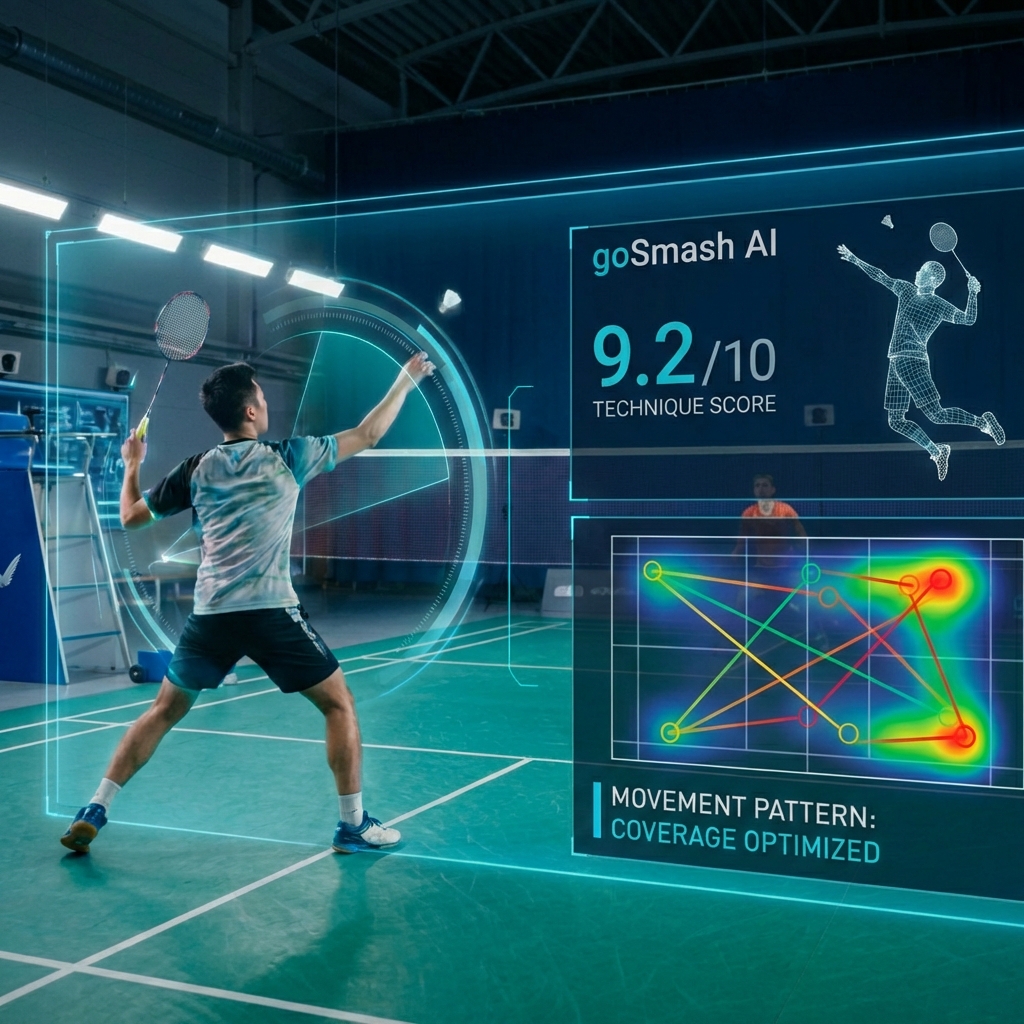
That's exactly what we built goSmash for. Upload a match — or a whole weekend of them in one batch — and the app does the shot census, technique scoring, and movement analysis automatically. It detects every shot, classifies it (smash, clear, drop, net, drive, lift, serve, push, block), scores your technique frame-by-frame, draws your court heatmap, and surfaces the patterns you'd have spent 90 minutes finding manually. You still do the thinking — but the grunt work is done in about five minutes.
Then an AI coach walks you through the findings in plain English and builds you a practice plan based on what it saw.
If that sounds useful, join the early access. It's free during the beta.
The bottom line
Self-analysis isn't glamorous. It's slow, it's humbling, and it takes discipline. But it's the single highest-leverage thing you can do outside of training. One hour of focused video review teaches you more about your game than ten hours of playing.
Start with one match. Use the framework above. Write down two specific drills. Do them. Record the next match. Repeat.
That's the loop. Everything else is noise.
Skip the 90-minute grind
goSmash does the shot-by-shot breakdown, technique scoring, and movement analysis automatically — so you can focus on fixing things instead of counting them.
Closed testing. No spam, and you can leave any time. Prefer the full form? Early access page.